

// post
Computer Networking: Transport Layer
计算机网络:传输层
- Transport layer services
- Multiplexing and demultiplexing
- Connectionless transport: UDP
- Principles of reliable data transfer
- Connection-oriented transport: TCP
- TCP congestion control
- Evolution of transport-layer functionality
Transport layer services
- provide logical communication between application processes running on different hosts
- transport protocols actions
- sender: breaks messages into segments, passes to network layer
- receiver: reassembles segments, passes to application layer
- 2 protocols
- TCP
- UDP
Multiplexing and demultiplexing
multiplexing: 复用
Sender handle data from multiple sockets, add transport header (later used for demultiplexing).
Receiver use header info to deliver received segments to correct socket.
Host uses IP addresses and port numbers to direct segment to appropriate socket.
- UDP: demultiplexing using destination port number (only)
- TCP: demultiplexing using 4-tuple: source and destination IP addresses, and port numbers
Connectionless transport: UDP
- “best effort” service
- segment may be lost or out of order
- connectionless, no hand shaking
Why we need UDP?
- No connection establishment
- Simple: no state
- No congestion control
Use case of UDP
- streaming multimedia apps
- DNS
- SNMP
- HTTP/3
If reliable transfer needed over UDP (e.g. HTTP/3):
- add reliability at application layer
- add congestion control at application layer
Internet checksum
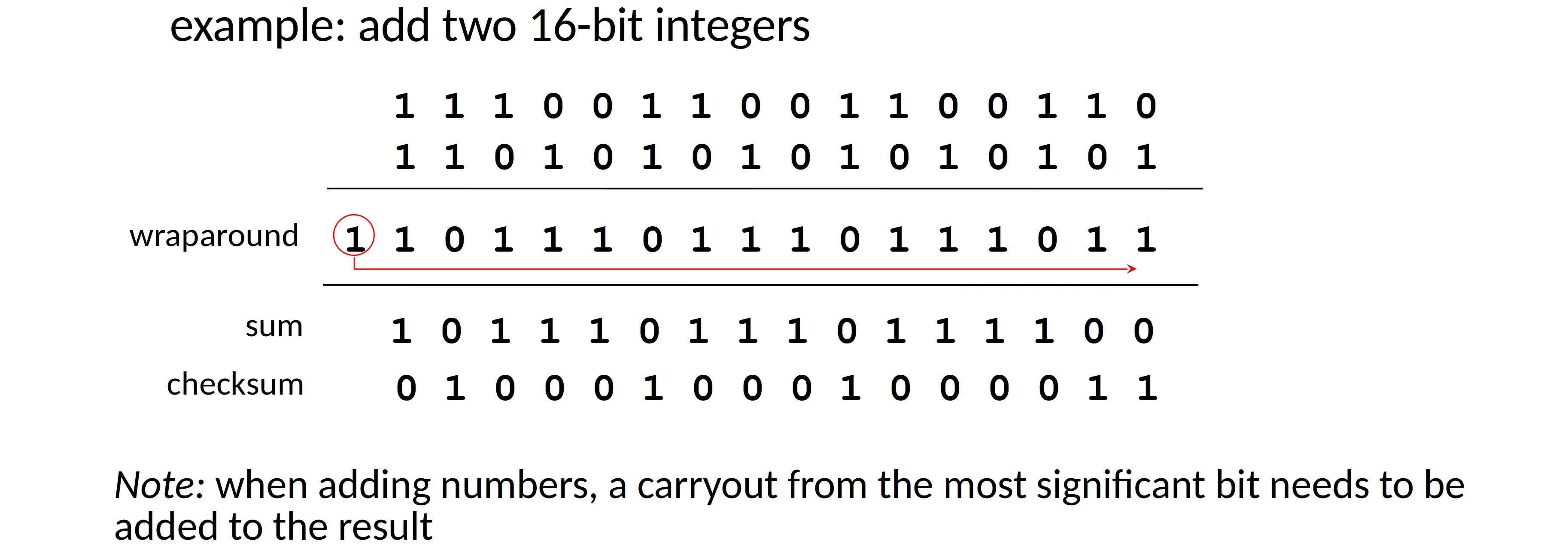
This is a weak protection, two flipped bits can have same checksum.
Principles of reliable data transfer
How to build reliable data transfer on top of unreliable channel?
rdt: reliable data transfer
rdt 1.0
Reliable transfer over a reliable channel: easy.
rdt 2.0
Channel with bit errors, how to recover?
- ACK: receiver explicitly tells sender that packet received OK
- NAK - negative ACK: receiver explicitly tells sender that packet had errors
- sender then retransmits packet on receipt of NAK
“Stop and wait”:
Sender sends one packet, then waits for receiver response.
Flaw of rdt 2.0:
- ACK or NAK can be corrupted
- stop and wait is slow
rdt 2.1
sender
- seq added to each packet
rdt 2.2
No NAK, use ACK of last seq instead.
rdt 3.0
Add a timer, which is set when a packet is sent, and sender will resend when timer goes off.
Still, performance is poor due to only one packet is in transfer each moment.
Pipe lining: increased utilization
Go Back N
- sender
- maintain a “window” of size up to N, with transmitted but unACKed packets
- cumulative ACK: receiving ACK seq
nmeans ACK all packets up to, including seqn
- receiver
- ACK only
- may generate duplicate ACKs
- need only remember the seq of next needed packet (in order)
- on receipt of out-of-order packet
- can discard or buffer these packets
- re-ACK the highest in-order seq
- ACK only
Selective repeat
- sender
- data from above: if net available seq in window, send packet
- timeout: resend packet
n, restart timer - ACK
nin[sendbase, sendbase + N-1]- mark packet
nas received - if
nsmallest unACKed packet, advance window base to next unACKed seq
- mark packet
- receiver
- packet
nin[rcvbase, rcvbase + N-1]- send ACK
n - out-of-order: buffer
- in-order: deliver, advance window to next not-yet-received packet
- send ACK
- packet
nin[rcvbase - N, rcvbase - 1]- ACK
n
- ACK
- otherwise: ignore
- packet
Connection-oriented transport: TCP
- point-to-point
- reliable, in-order byte steam
- full duplex data
- cumulative ACKs
- pipe lining
- connection-oriented
- flow controlled
rdt in TCP
Timer setting
TCP round trip time, timeout:
- here is a “safety margin”
- typically,
- typically,
TCP fast retransmit
If sender receives 3 additional ACKs for same data (“triple duplicate ACKs”), resend unACKed segment with smallest seq, because it is likely that unACKed segment lost, so don’t wait for timeout.
Flow control
Receiver controls sender, so sender won’t overflow receiver’s buffer by transmitting too much, too fast.
TCP receiver put the free buffer space left in rwnd field in TCP header,
sender limits amount of packets to the size of rwnd.
Connection management
Before exchanging data, sender and receiver do “handshake”.
- Agree to establish connection
- Agree on connection parameters (e.g. starting seq)
Establishing TCP connection
Why 2-way handshake don’t work in all scenarios:
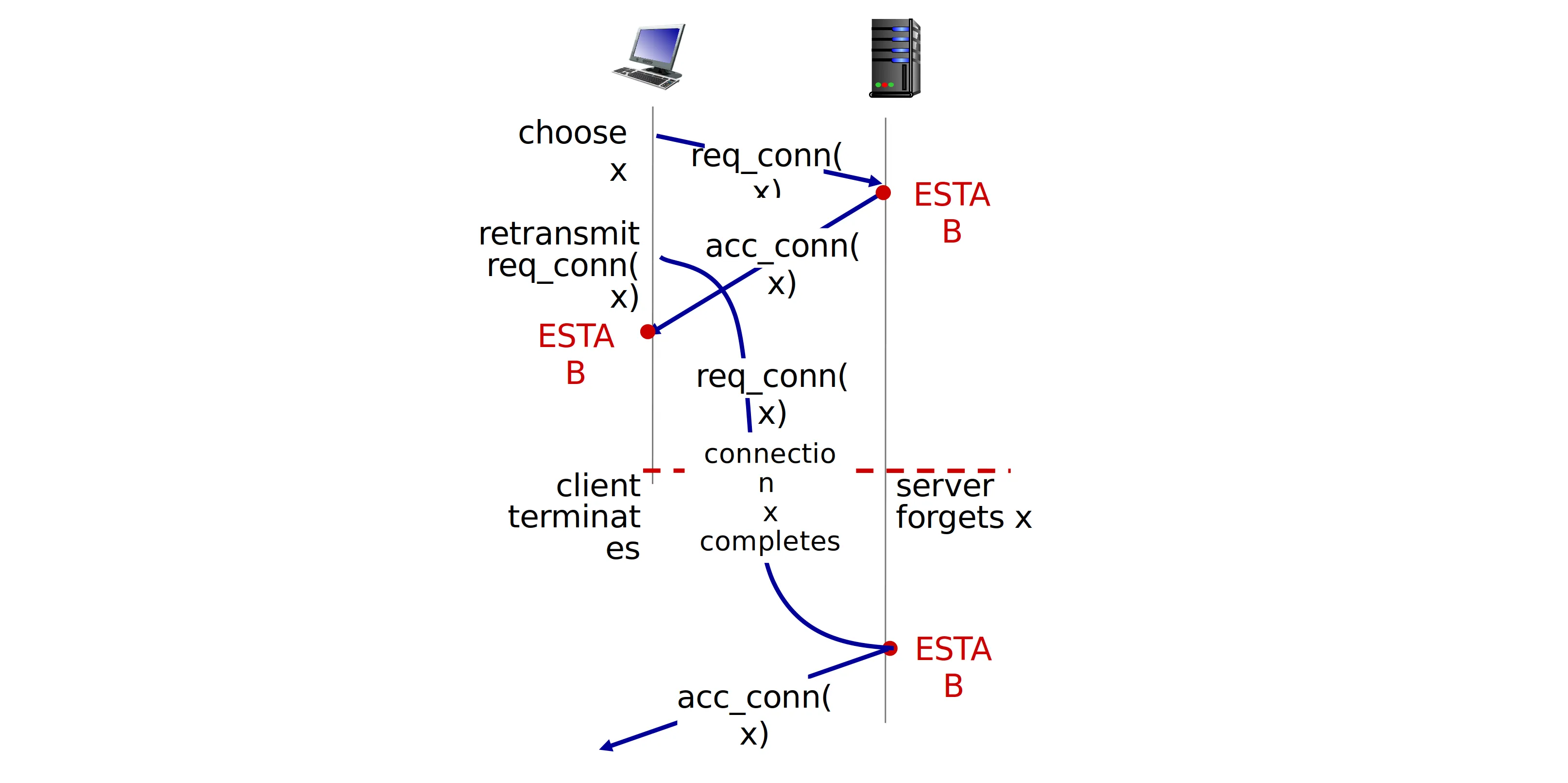
and here is a never ending half open connection with no client
TCP 3-way handshake
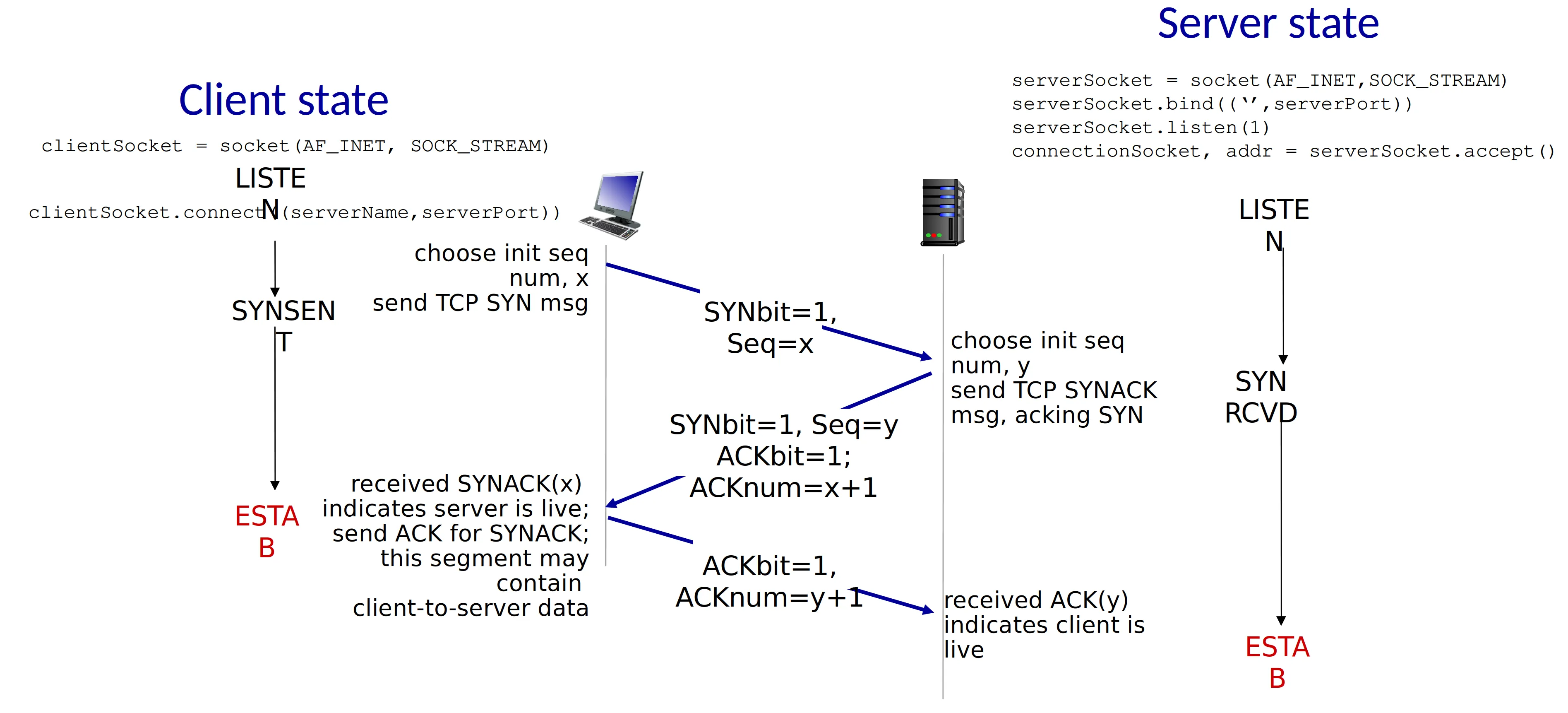
Closing TCP connection
- client, server each close their side of connection
- send TCP segment with
FINbit = 1
- send TCP segment with
- respond to received
FINwith ACK- on receiving
FIN, ACK can be combined with ownFIN
- on receiving
- simultaneous
FINexchanges can be handled
TCP congestion control
Approaches towards congestion control
- End-end congestion control
- Network-assisted congestion control
Throughput based TCP congestion control: AIMD
Additive Increase and Multiplicative Decrease
Sending rate is cut in half on loss detected by triple duplicate ACK, and cut to 1 MSS (maximum segment size) when loss detected by timeout.
Why AIMD?
- Optimize congested flow rates network wide
- have desirable stability properties
TCP sending behavior
TCP sender limits transmission
TCP slow start:
When connection begins, increase rate exponentially until first loss event.
Initially, cwnd = 1 MSS, double cwnd every RTT.
Done by incrementing cwnd for every ACK received.
TCP CUBIC: By contrast with TCP Reno, which increases linearly, CUBIC increase TCP sending rate gradually slower when approaching K.
K: point in time when TCP window size will reach
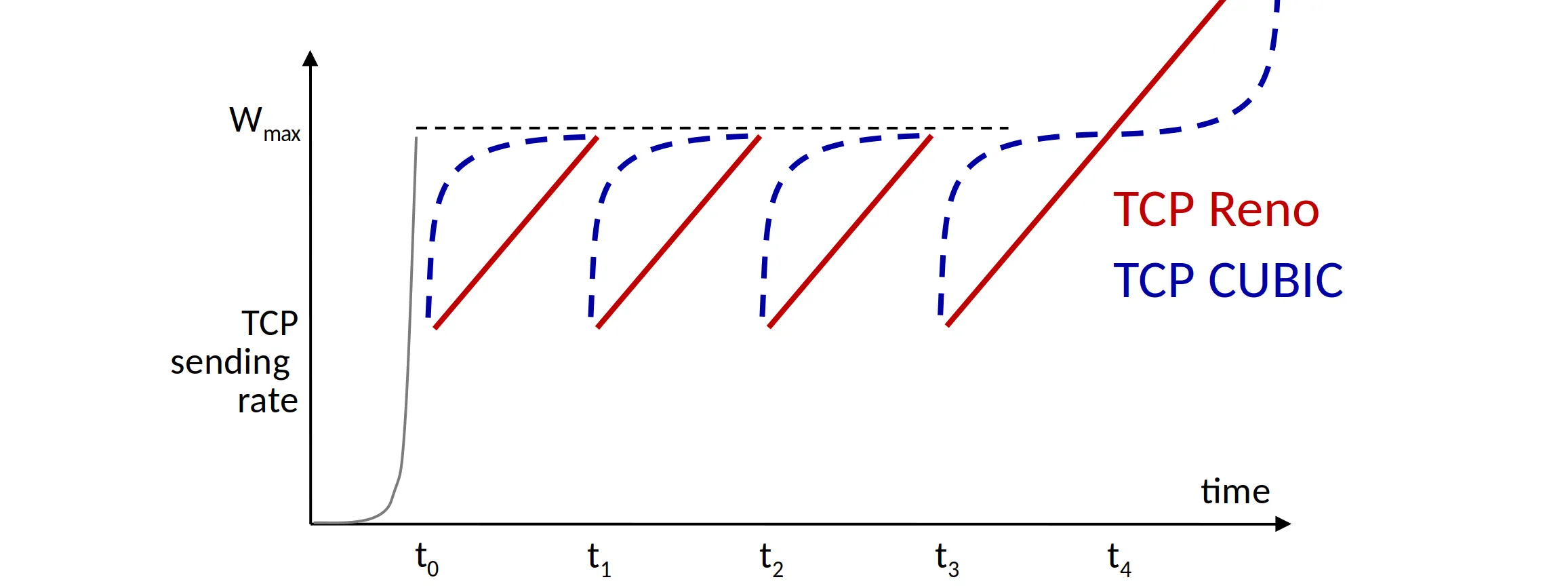
Delay based TCP congestion control
Explicit congestion notification: “detect congestion before loss occurs”.
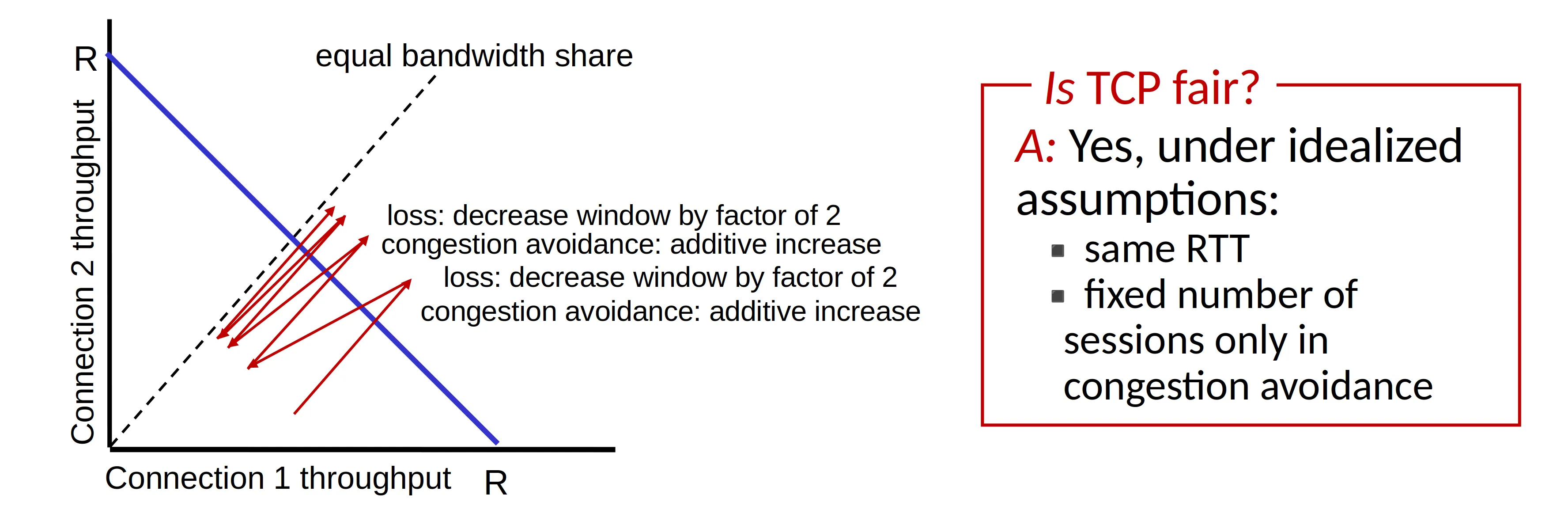
TCP fairness
The general goal: If K TCP sessions share same bottleneck link of bandwidth R, each should have average rate of .
Evolution of transport-layer functionality
Evolving transport layer functionality
QUIC: Quick UDP Internet Connections