

// post
Computer Networking: Security
计算机网络:安全
- Principles
- Message integrity, authentication
- Securing e-mail
- Securing TCP: TLS
- Network layer security: IPsec
- Security in wireless and mobile networks
- Firewall and IDS
- Confidentiality 保密
- Authentication
- Message integrity
- Access and availability
Analogy used down below: Alice, Bob, Trudy. Alice wants to communicate with Bob, Trudy is the bad person.
Principles
Simple encryption scheme
Symmetric key crypto
Caesar cipher
Public Key Cryptography
- sender, receiver do not share secret key
- public encryption key known to all
- private decryption key known only to receiver
Requirements:
- : public key
- : private key
Given public key, it should be impossible to compute private key.
RSA algorithm: another important property
In practice, because DES is at least 100 times faster than RSA, we actually use RSA to exchange a session specific symmetric key, and communicate through symmetric encryption.
Message integrity, authentication
1.0 No authentication
2.0 Alice provide her name
Still, Trudy can pretend to be Alice.
3.0 Alice provide her name and her IP address
Still, Trudy can pretend if she gets Alice’s IP address, which is not hard at all.
3.5 Alice provide an encrypted password in addition
Trudy can record Alice’s packet, and “play it back” to Bob, without knowing the encryption key at all.
4.0 Bob sends Alice a nonce: R, Alice must return K(R)
K() is their shared symmetric key
Can we authenticate using public key techniques?
5.0 Nonce with public key cryptography
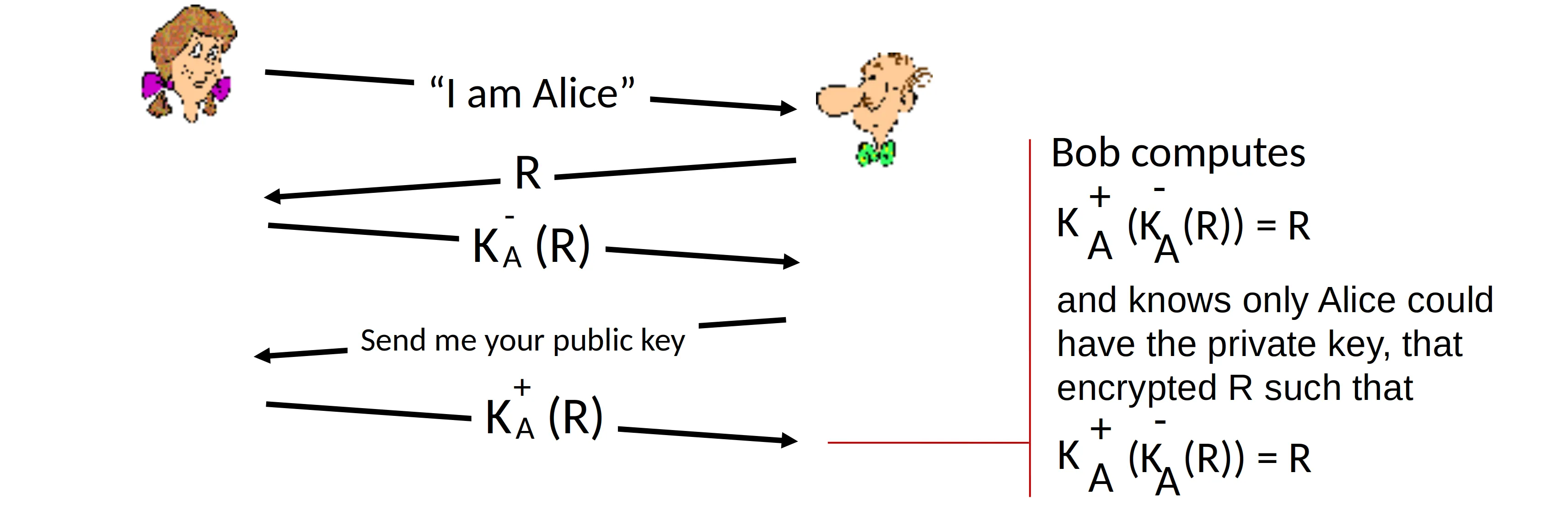
Still a flaw: man in the middle attack. Trudy pretend to be Bob facing Alice, and pretend to be Alice facing Bob.
Solution: Digital signatures certificate
Digital signature: signed message digest
6.0 Public key Certification Authority
In addition to 5.0, we add a 3rd party CA which binds public key to particular entity.
CA broadcast it’s public key, so nobody can pretend to be CA.
Securing e-mail
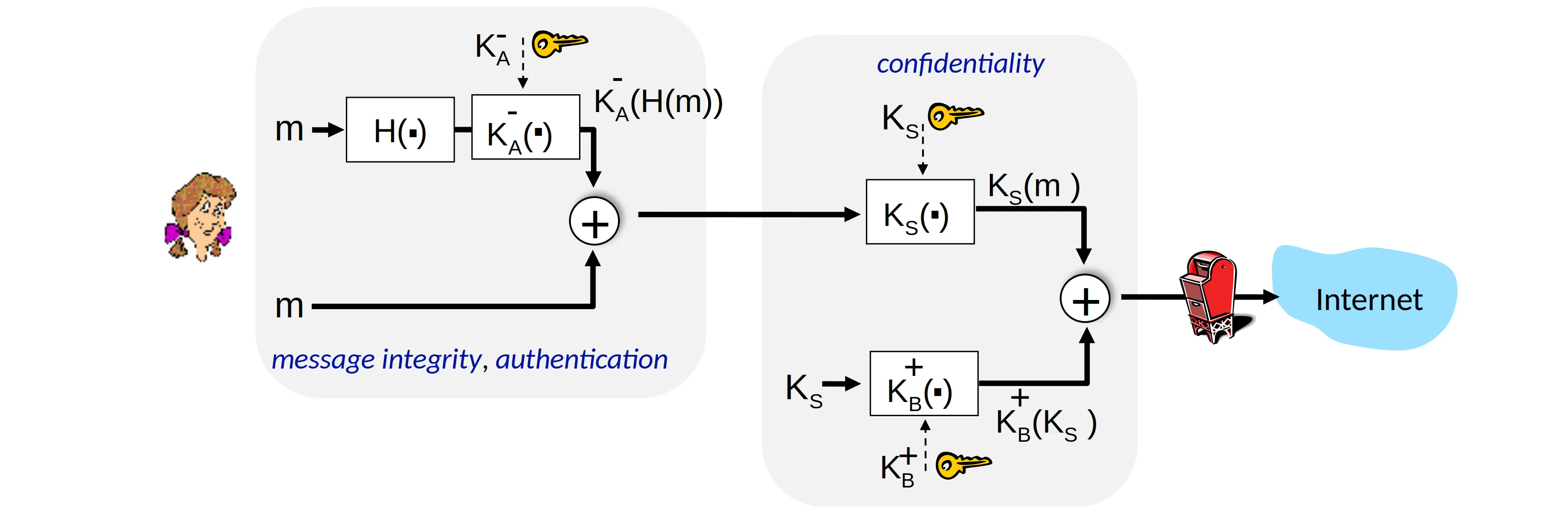
Alice uses three keys: her private key, Bob’s public key, new symmetric key.
Securing TCP: TLS
TLS: Transport Layer Security
- Bob establishes TCP connection with Alice
- Bob verifies that Alice is really Alice
- Bob sends Alice a master secret key (MS), used to generate all other keys for TLS session
- Potential issue: 3 RTT before client can start receiving data (including TCP handshake)
Use 4 keys for each cryptographic function
- encryption key for data sent from client to server
- MAC key for data sent from client to server
- encryption key for data sent from server to client
- MAC key for data sent from server to client
Possible attacks on data stream
- re-ordering
- replay
Solutions
- add TLS sequence numbers
- use nonce
Network layer security: IPsec
Provides datagram level encryption, authentication, integrity, for both user traffic and control traffic (e.g., BGP, DNS messages).
With 2 modes
- transport mode: only datagram payload is encrypted, authenticated
- tunnel mode: entire datagram is encrypted, authenticated, encrypted datagram encapsulated in new datagram with new IP header, tunneled to destination
2 IPsec protocols
- Authentication Header (AH) protocol
- Encapsulation Security Protocol (ESP)
Security in wireless and mobile networks
WPA3 handshake: used in 802.11
- AS generates , sends to mobile
- Mobile receives
- generates
- generates symmetric shared session key using , , and initial shared secret
- sends , and HMAC-signed value using and initial shared secret
- AS derives symmetric shared session key
Authentication, encryption in 4G LTE have notable differences.
- Mobile’s SIM card provides global identity, contains shared keys.
- Services in visited network depend on (paid) service subscription in home network.
Firewall and IDS
Firewall isolates organization’s internal network from larger Internet, allowing some packets to pass, blocking others
- prevent denial of service attacks
- prevent illegal modification/access of internal data
- allow only authorized access to inside network
- three types of firewalls
- stateless packet filters
- stateful packet filters
- application gateways