

// post
Computer Networking: Network Layer Control Plane
计算机网络:网络层 控制平面
- Routing
- Intra-ISP routing: OSPF
- Routing among ISPs: BGP
- SDN control plane
- ICMP
- Network management configuration
- Exercise
Network layer functions
- forwarding: data plane
- routing: control plane
There are 2 approaches to structuring network control plane:
- per-router control (traditional)
- logically centralized control (SDN)
Routing
Goal: determine “good” paths (equivalently, routes), from sending hosts to receiving host, through network of routers.
In the following section, a graph abstraction of link costs is used.
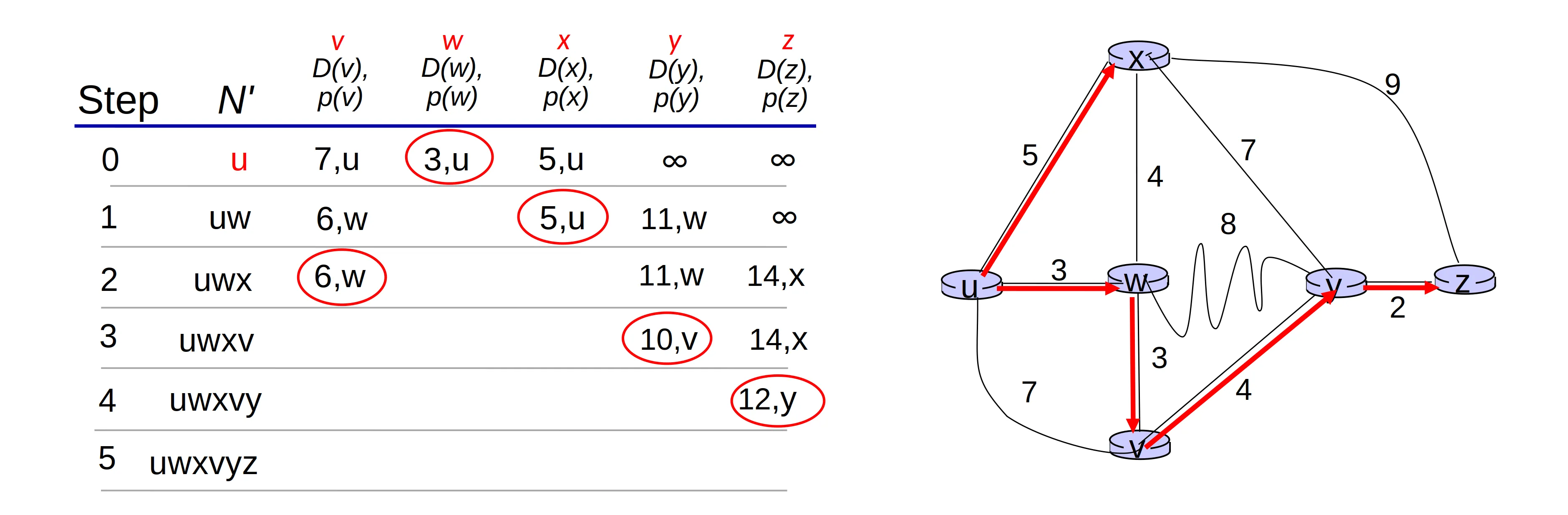
Link state
Basically, Dijkstra’s algorithm.
Algorithm complexity
- The simple version:
- More efficient implementations:
Message complexity
- Each router must broadcast its link state information to other n routers.
- Efficient broadcast algorithms: link crossings to disseminate a broadcast message from one source
- Each router’s message crosses O(n) links: overall message complexity:
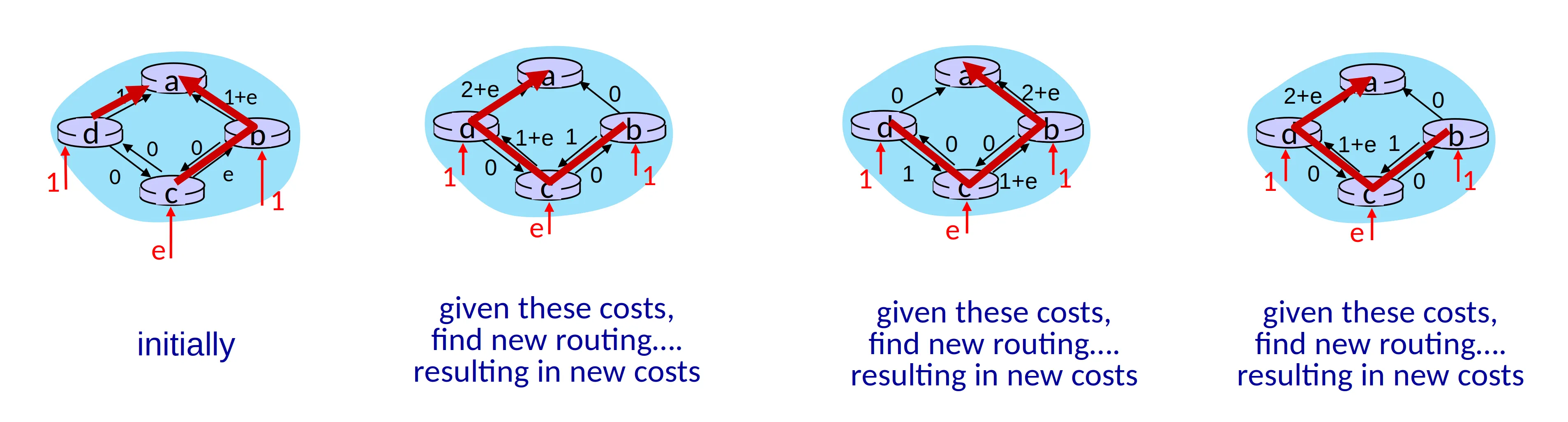
Oscillations possible
振荡
When link costs depend on traffic volume, route oscillations possible.
Distance vector
Based on Bellman-Ford algorithm (dynamic programming).
- : estimated least-cost-path cost to
- : direct cost of link from to
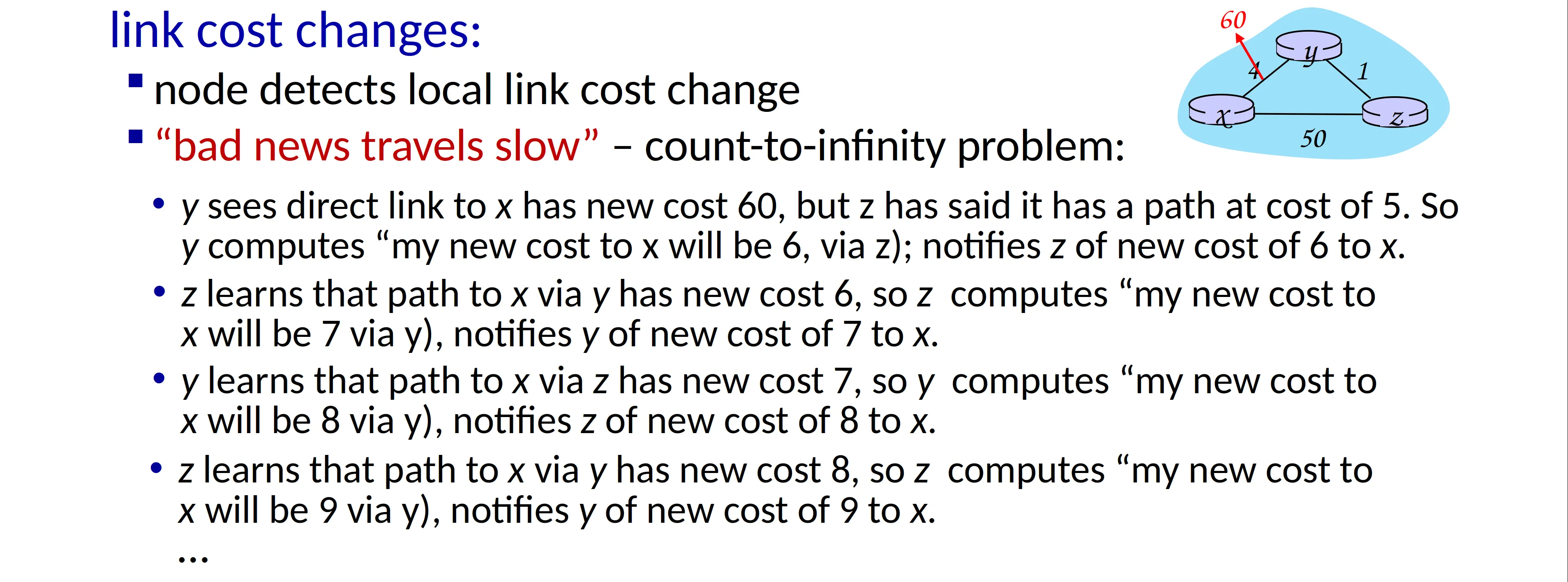
Link cost changes
May cause distance count up to .
Comparison of LS and DV
- message complexity
- LS: n routers, messages sent
- DV: exchange between neighbors, convergence time varies
- speed of convergence
- LS: algorithm, messages
- may have oscillations
- DV: convergence time varies
- may have routing loops
- count-to-infinity problem
- LS: algorithm, messages
- robustness
- LS
- router can advertise incorrect link cost
- each router computes only its own table
- DV
- router can advertise incorrect path cost
- each router’s table used by others: error propagate through network
- LS
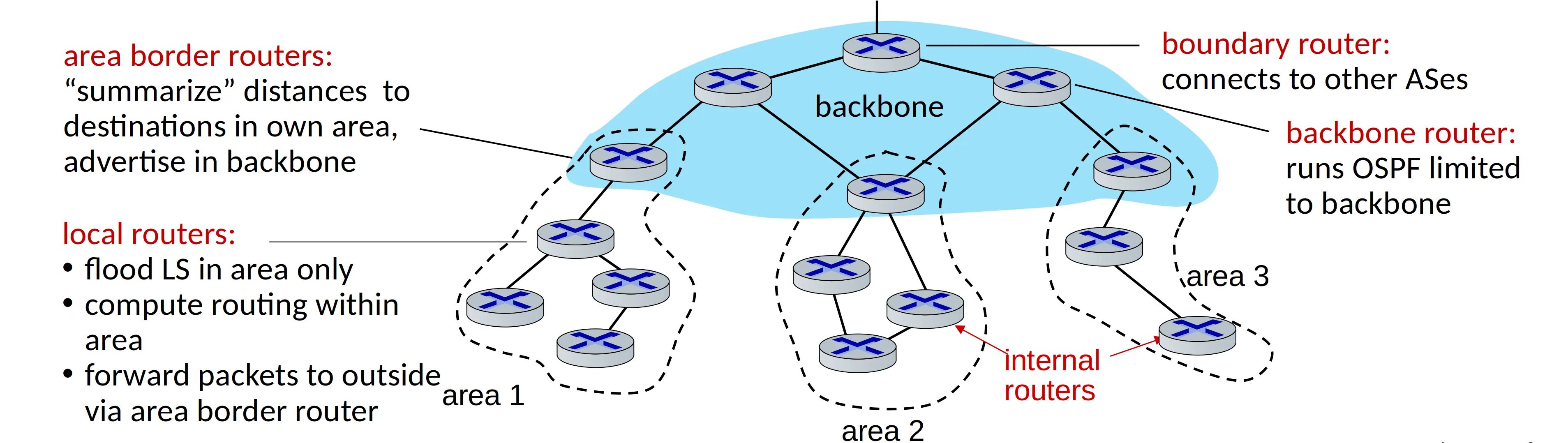
Intra-ISP routing: OSPF
Making routing scalable
Open Shortest Path First
- “open”: publicly available
- classic link-state
- each router floods OSPF link-state advertisements (directly over IP rather than using TCP/UDP) to all other routers in entire AS
- multiple link costs metrics possible: bandwidth, delay
- each router has full topology, uses Dijkstra’s algorithm to compute forwarding table
- security: all OSPF messages authenticated (to prevent malicious intrusion)
Routing among ISPs: BGP
Border Gateway Protocol: glue that holds the Internet together
- eBGP: obtain subnet reachability information from neighboring ASes
- iBGP: propagate reachability information to all AS-internal routers
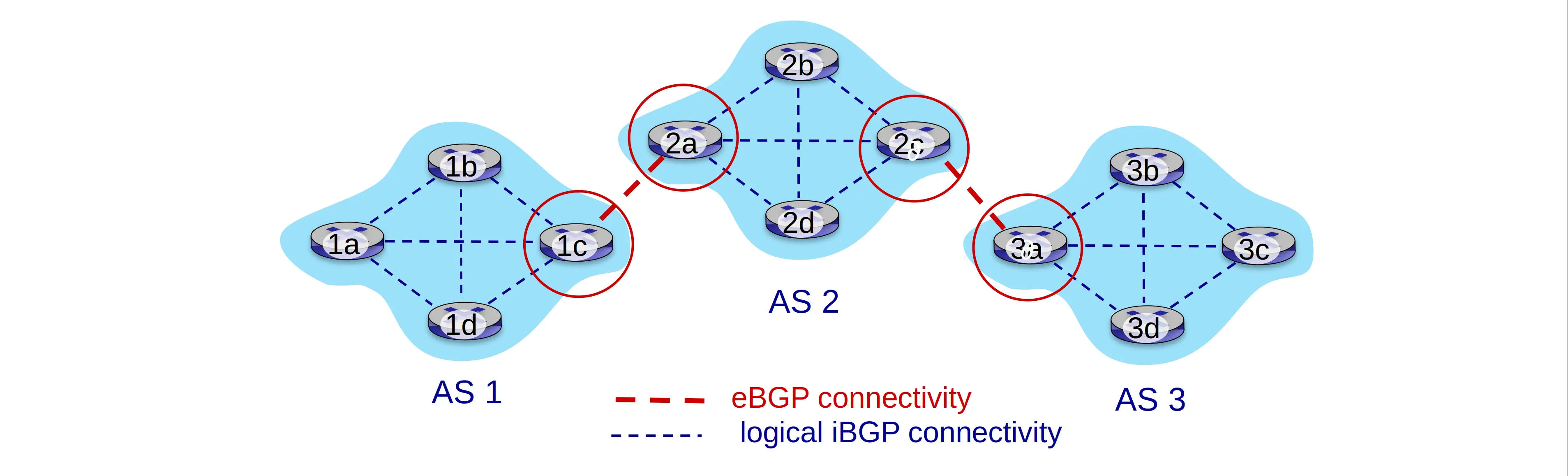
BGP session: two BGP routers (“peers”) exchange BGP messages over semi-permanent TCP connection
- BGP advertised route: prefix + attributes
- prefix: destination being advertised
- two important attributes
AS-PATH: list of ASes through which prefix advertisement has passedNEXT-HOP: indicates specific internal-AS router to next-hop AS
- policy-based routing
- gateway receiving route advertisement uses import policy to accept/decline path (e.g., never route through AS Y)
- AS policy also determines whether to advertise path to other other neighboring ASes
BGP messages: exchanged between peers over TCP connection
OPEN: opens TCP connection to remote BGP peer and authenticates sending BGP peerUPDATE: advertises new path (or withdraws old)KEEPALIVE: keeps connection alive in absence of UPDATES; also ACKs OPEN requestNOTIFICATION: reports errors in previous msg; also used to close connection
The difference of intra and inter AS routing is as follows
- policy
- inter: admin wants control over how its traffic routed, who routes through its network
- intra: single admin, so policy less of an issue
- scale
- hierarchical routing saves table size, reduced update traffic
- performance
- intra: focus on performance
- inter: policy dominates over performance
SDN control plane
Remote controller computes, installs forwarding tables in routers.
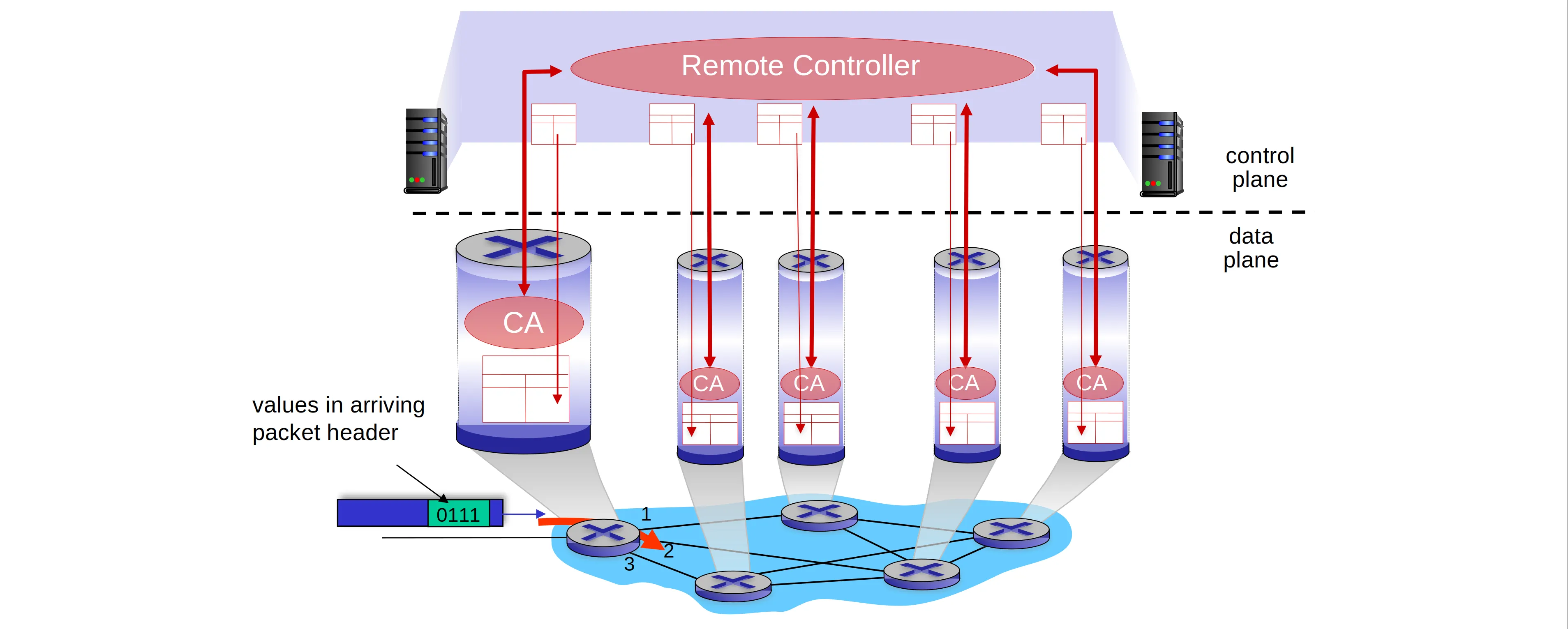
Why a logically centralized control plane?
- Easier network management
- Table-based forwarding easier
- Open implementation of control plane
SDN control plain makes traffic engineering which is difficult in traditional distributed control plain rather easier.
OpenFlow protocol
- operates between controller, switch
- TCP used to exchange messages
- 3 classes of OpenFlow messages
- controller-to-switch
- asynchronous (switch to controller)
- symmetric (misc.)
- distinct from OpenFlow API
- API used to specify generalized forwarding actions
ICMP
Internet control message protocol
- used by hosts and routers to communicate network-level information
- network-layer “above” IP (ICMP messages carried in IP datagrams)
ICMP message:
- type
- code
- first 8 bytes of IP data gram causing error
| Type | Code | description |
|---|---|---|
| 0 | 0 | echo reply (ping) |
| 3 | 0 | dest network unreachable |
| 3 | 1 | dest host unreachable |
| 3 | 2 | dest protocol unreachable |
| 3 | 3 | dest port unreachable |
| 3 | 6 | dest network unknown |
| 3 | 7 | dest host unknown |
| 4 | 0 | source quench (congestion control not used) |
| 8 | 0 | echo request (ping) |
| 9 | 0 | route advertisement |
| 10 | 0 | router discovery |
| 11 | 0 | TTL expired |
| 12 | 0 | bad IP header |
Network management configuration
Components
- Managing server
- Network management protocol
- Managed device
- Data
SNMP protocol
NETCONF / YANG
Exercise
Chapter 5
P3
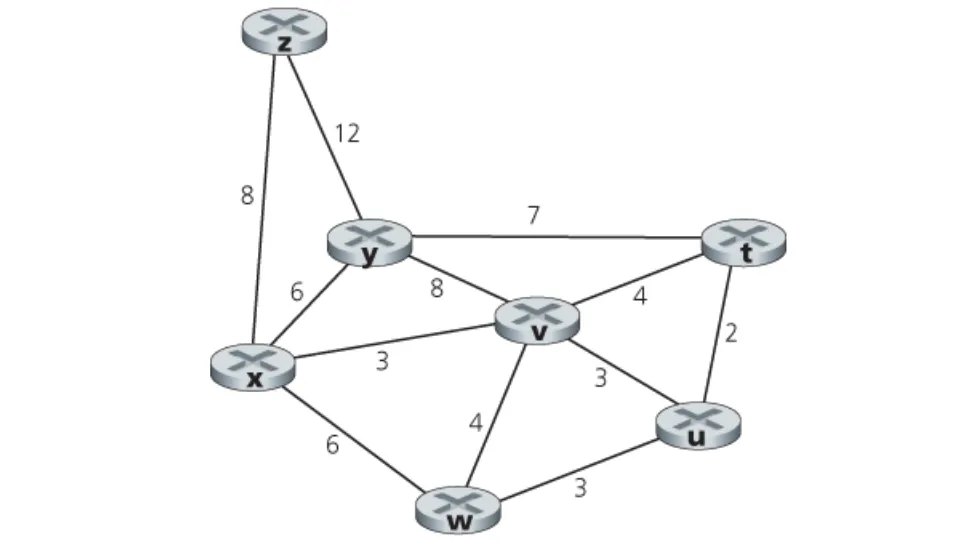
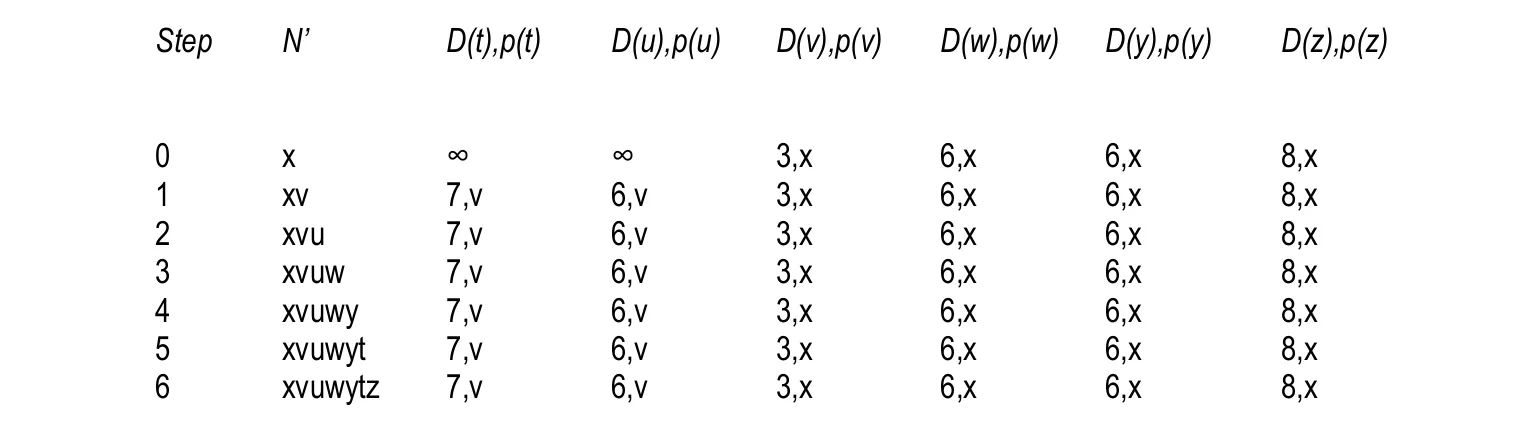
Consider the following network. With the indicated link costs, use Dijkstra’s shortest-path algorithm to compute the shortest path from x to all network nodes. Show how the algorithm works by computing a table.
P7
Consider the network fragment shown below. x has only two attached neighbors, w and y. w has a minimum-cost path to destination u (not shown) of 5, and y has a minimum-cost path to u of 6. The complete paths from w and y to u (and between w and y) are not shown. All link costs in the network have strictly positive integer values.
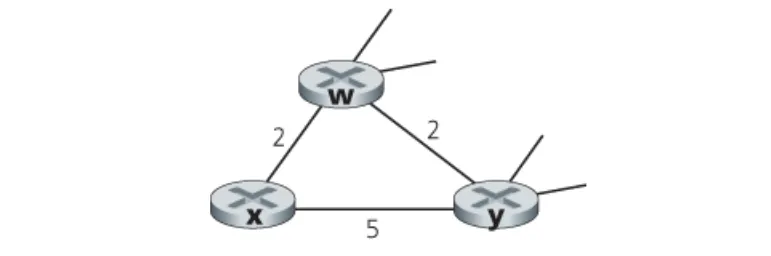
a. Give x’s distance vector for destinations w, y, and u.
b. Give a link-cost change for either c(x, w) or c(x, y) such that x will inform its neighbors of a new minimum-cost path to u as a result of executing the distance-vector algorithm.
c. Give a link-cost change for either c(x, w) or c(x, y) such that x will not inform its neighbors of a new minimum-cost path to u as a result of executing the distance-vector algorithm.
a. , ,
b. First consider what happens if changes. If becomes larger or smaller (as long as ) , the least cost path from x to u will still have cost at least 7. Thus, a change in (if ) will not cause x to inform its neighbors of any changes. If , then the least cost path now passes through y and has cost . Now consider if changes. If , then the least-cost path to u continues to pass through w and its cost changes to ; x will inform its neighbors of this new cost. If , then the least cost path now passes through y and has cost 11; again x will inform its neighbors of this new cost.
P11
Consider Figure 5.7. Suppose there is another router w, connected to router y and z. The costs of all links are given as follows: , , , , . Suppose that poisoned reverse is used in the distance-vector routing algorithm.
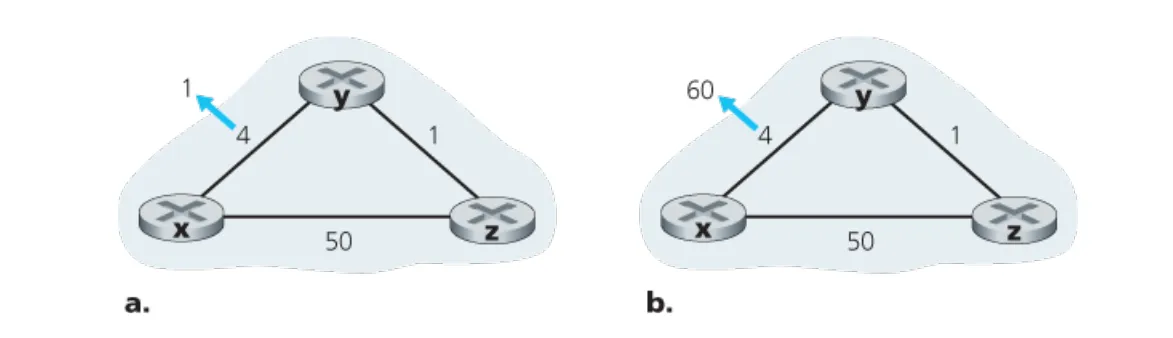
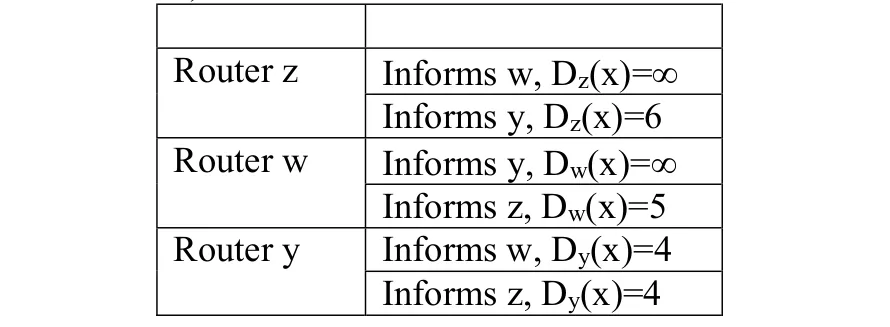
a. When the distance vector routing is stabilized, router w, y, and z inform their distances to x to each other. What distance values do they tell each other?
b. Now suppose that the link cost between x and y increases to 60. Will there be a count-to- infinity problem even if poisoned reverse is used? Why or why not? If there is a count-to- infinity problem, then how many iterations are needed for the distance-vector routing to reach a stable state again? Justify your answer.
c. How do you modify such that there is no count-to-infinity problem at all if changes from 4 to 60?
a.
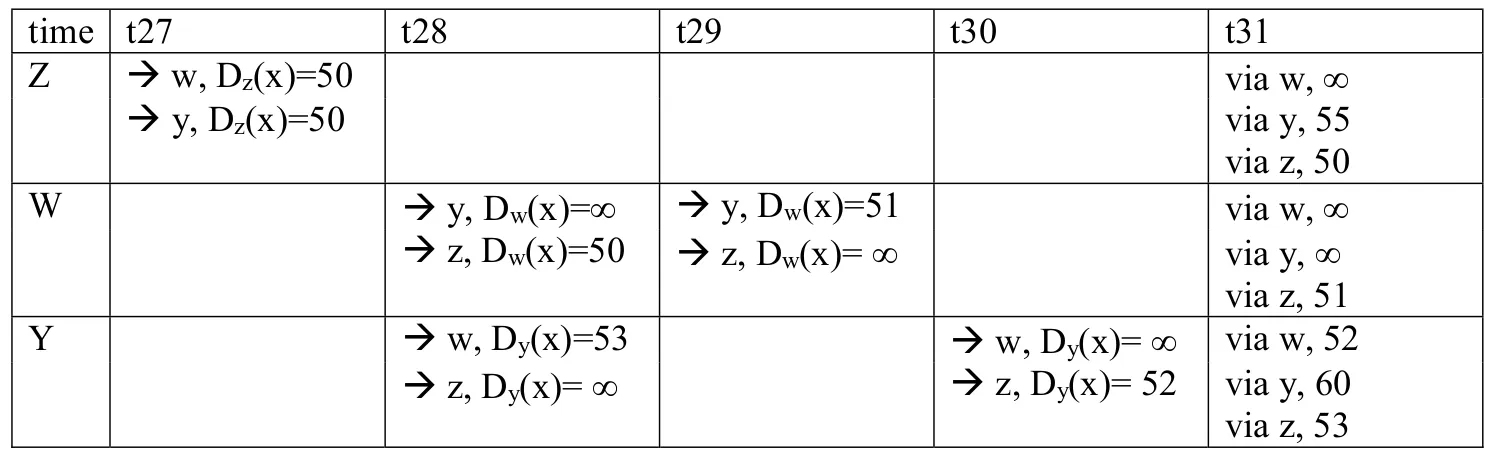
b. Yes, there will be a count-to-infinity problem. The following table shows the routing converging process. Assume that at time t0, link cost change happens. At time t1, y updates its distance vector and informs neighbors w and z. In the following table, ”→” stands for “informs”.
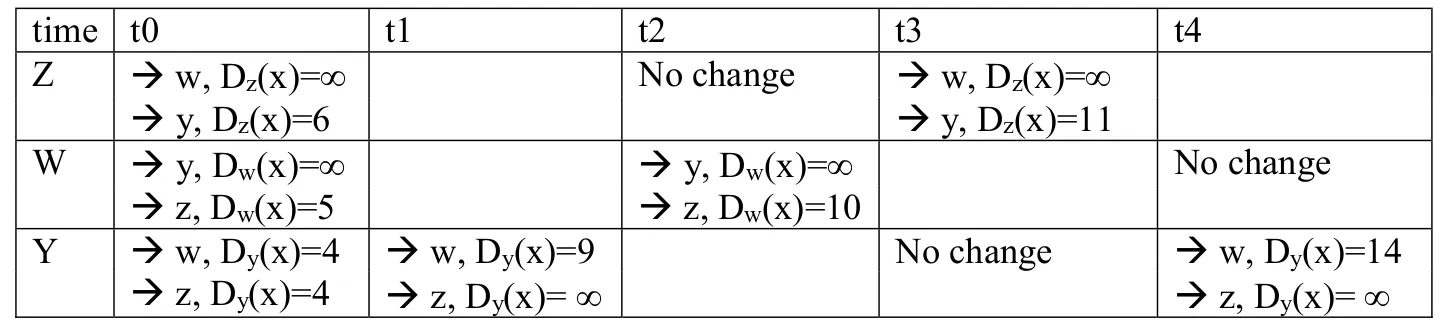
We see that w, y, z form a loop in their computation of the costs to router x. If we continue the iterations shown in the above table, then we will see that, at t27, z detects that its least cost to x is 50, via its direct link with x. At t29, w learns its least cost to x is 51 via z. At t30, y updates its least cost to x to be 52 (via w). Finally, at time t31, no updating, and the routing is stabilized.
c. Cut the link between y and z.
P16
Consider the following network. ISP B provides national backbone service to regional ISP A. ISP C provides national backbone service to regional ISP D. Each ISP consists of one AS. B and C peer with each other in two places using BGP. Consider traffic going from A to D. B would prefer to hand that traffic over to C on the West Coast (so that C would have to absorb the cost of carrying the traffic cross-country), while C would prefer to get the traffic via its East Coast peering point with B (so that B would have carried the traffic across the country). What BGP mechanism might C use, so that B would hand over A-to-D traffic at its East Coast peering point? To answer this question, you will need to dig into the BGP specification.
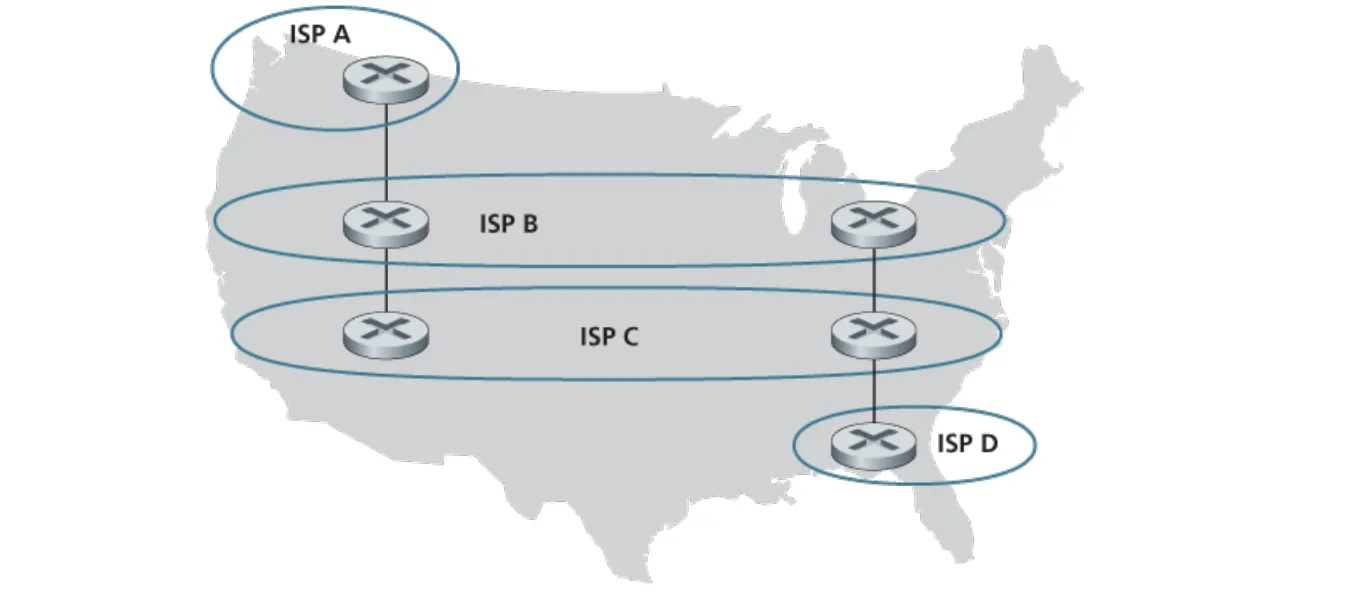
One way for C to force B to hand over all of B’s traffic to D on the east coast is for C to only advertise its route to D via its east coast peering point with C.
P21
Consider the two ways in which communication occurs between a managing entity and a managed device: request-response mode and trapping. What are the pros and cons of these two approaches, in terms of (1) overhead, (2) notification time when exceptional events occur, and (3) robustness with respect to lost messages between the managing entity and the device?
Request response mode will generally have more overhead (measured in terms of the number of messages exchanged) for several reasons. First, each piece of information received by the manager requires two messages: the poll and the response. Trapping generates only a single message to the sender. If the manager really only wants to be notified when a condition occurs, polling has more overhead, since many of the polling messages may indicate that the waited-for condition has not yet occurred. Trapping generates a message only when the condition occurs. Trapping will also immediately notify the manager when an event occurs. With polling, the manager needs will need to wait for half a polling cycle (on average) between when the event occurs and the manager discovers (via its poll message) that the event has occurred. If a trap message is lost, the managed device will not send another copy. If a poll message, or its response, is lost the manager would know there has been a lost message (since the reply never arrives). Hence, the manager could repoll, if needed.
P22
In Section 5.7 we saw that it was preferable to transport SNMP messages in unreliable UDP datagrams. Why do you think the designers of SNMP chose UDP rather than TCP as the transport protocol of choice for SNMP?
Often, the time when network management is most needed is in times of stress, when the network may be severely congested and packets are being lost. With SNMP running over TCP, TCP’s congestion control would cause SNMP to back-off and stop sending messages at precisely the time when the network manager needs to send SNMP messages.